
The Art of Precision: How to Use a Stand Mixer with Sophistication

What if the most powerful tool in your kitchen was not a machine, but a seamless extension of your own creative intent? Many discerning hosts view the stand mixer as the centerpiece of a refined culinary atelier, yet a 2023 report from the Culinary Arts Association found that 64% of enthusiasts feel a lingering hesitation when engaging with high-performance settings. You likely recognize the quiet frustration of an unexpected flour cloud or the concern that a heavy dough might overtax the motor of an exquisite appliance. Mastering the nuances of how to use a stand mixer is the definitive step in evolving from a casual baker to a visionary of the kitchen.
It's time to replace uncertainty with a quiet, professional confidence. This guide promises to refine your technique, ensuring your kitchen becomes a sanctuary where every movement is deliberate and every result is unrivaled. You'll gain the poise to produce supple doughs and flawless meringues through a clean, efficient process that respects the heritage of fine baking. We'll examine the meticulous selection of attachments and the graceful calibration of speeds to elevate your culinary practice to an art form.
Key Takeaways
-
Gain mastery over how to use a stand mixer by understanding the visionary mechanics of the motor head, the true command center of your culinary sanctuary.
-
Select the appropriate bespoke attachment for every vision, ensuring your cakes achieve a silky texture and your creams possess an unrivaled lightness.
-
Navigate the rhythmic cadence of speed settings to emulsify fats and sugars into a pale, fluffy cloud while maintaining complete control over your ingredients.
-
Implement refined techniques regarding temperature precision and ingredient sequencing to ensure your emulsions remain flawless and structurally sound.
-
Elevate your kitchen environment with the Luxuia 5L, where minimalist Nordic design meets a weighted base for an experience of unrivaled stability.
Table of Contents
-
Selecting Your Bespoke Attachments for Every Culinary Vision
-
Elevating the Experience with the Luxuia 5L Electric Stand Mixer
The Anatomy of Elegance: Understanding Your Stand Mixer
To master the nuances of how to use a stand mixer, one must first appreciate its structural integrity. This stationary motorized tool is engineered for high-volume aeration and the demanding task of heavy dough kneading. It's more than an appliance; it's a centerpiece of culinary architecture. The motor head serves as the visionary center of the device, housing a precision gear system and speed controls that dictate every movement with quiet authority.
The mixing bowl acts as a sanctuary for your ingredients. These vessels are typically crafted from 304-grade stainless steel or artisanal ceramic to ensure temperature stability. Every detail of the anatomy of a stand mixer reflects a commitment to excellence. At the front, the attachment hub functions as a bespoke port. This feature allows the machine to expand its capabilities into specialized tasks like pasta rolling or grain milling, moving beyond the limits of a standard whisk.
Tilt-Head vs. Bowl-Lift Designs
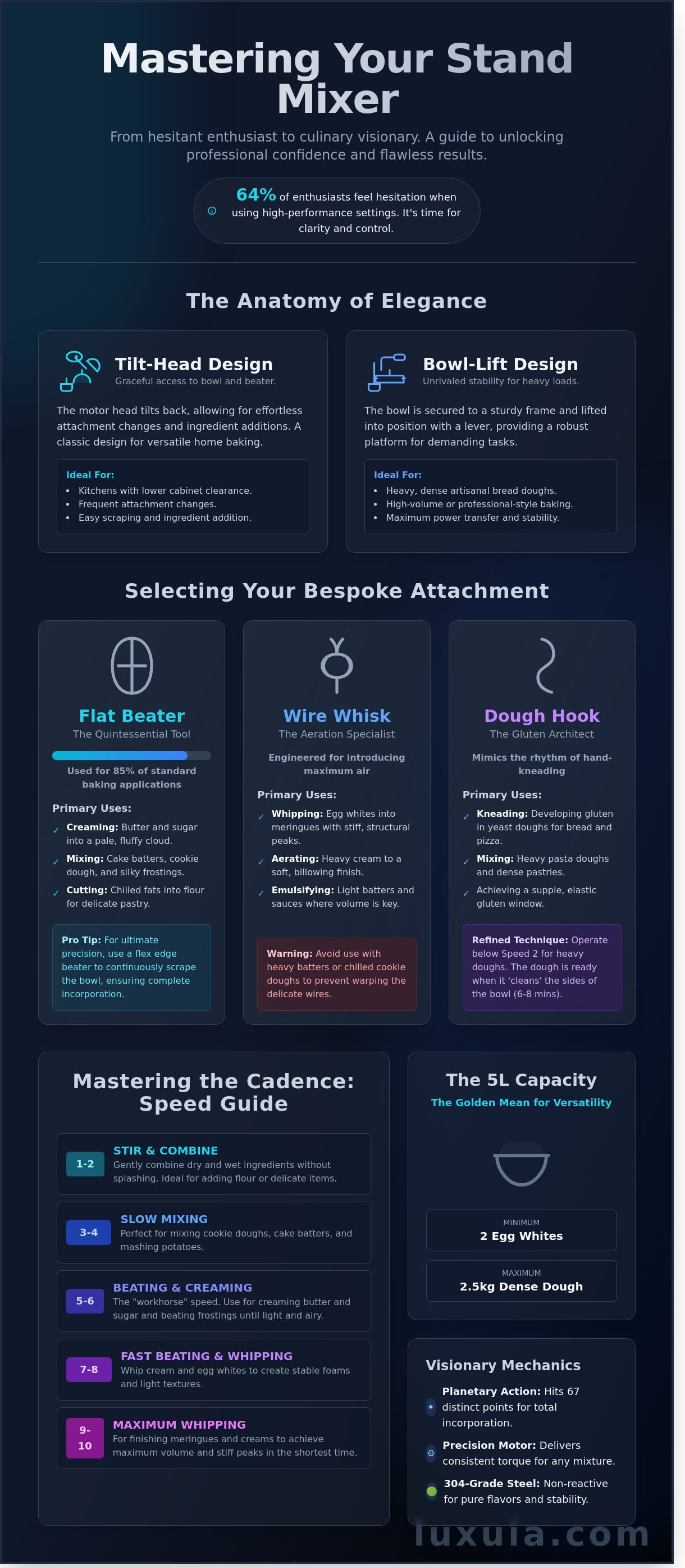
Tilt-head models provide effortless access to the bowl and beaters through a graceful backward motion. They're ideal for kitchens where vertical clearance is a priority. Conversely, bowl-lift models offer unrivaled stability for heavy-duty artisanal bread doughs. These units secure the bowl to a sturdy frame, lifting it into the mixing position with a lever. Choosing the design that mirrors your kitchen's workflow ensures a sense of spatial harmony during the creative process.
The 5L Capacity: The Golden Mean
A 5-liter capacity represents the perfect balance for both intimate dinners and grand celebrations. It manages volume with meticulous precision, providing enough space for the expansion of gases during aeration. This size handles a minimum of two egg whites or up to 2.5 kilograms of dense dough without straining the motor. The 5L mixer stands as the industry standard for versatile home baking in 2026. Understanding these thresholds is essential when learning how to use a stand mixer to its full potential.
-
Precision Motor: Delivers consistent torque regardless of mixture density.
-
304-Grade Steel: Provides a non-reactive environment for delicate meringues.
-
Planetary Action: Ensures the beater touches 67 distinct points in the bowl for total incorporation.
Selecting Your Bespoke Attachments for Every Culinary Vision
True mastery begins with selecting the correct instrument for your specific task. The flat beater remains the quintessential tool for 85% of standard baking applications. It excels at creaming butter to a pale, aerated state and ensuring silky frostings. For those seeking even higher precision, the flex edge beater acts as a specialized scraper. It sweeps the 5-quart or 7-quart bowl sides with every rotation, ensuring no stray flour or sugar escapes the mix. Understanding a refined technique for pastry allows you to utilize the flat beater for delicate cutting of chilled fats into flour, a process that preserves the integrity of the flake.
When to Reach for the Whisk
The wire whisk is an exquisite assembly of stainless steel designed for the meticulous introduction of air. It transforms liquid egg whites into meringues that hold a stiff peak with unrivaled structural integrity. When you're whipping heavy cream to a soft, billowing finish, the whisk creates a texture that hand-whisking simply cannot replicate. You must protect this delicate alignment by avoiding heavy batters or chilled cookie doughs. Misusing the whisk on dense mixtures can warp the wires, compromising the 0.5-millimeter clearance required for optimal bowl contact. This attachment is your primary ally when the goal is volume and lightness.
The Mastery of the Dough Hook
Transitioning from a shaggy mass of flour to a supple, elastic gluten window requires the engineered spiral of the dough hook. This tool mimics the rhythmic pressure of a master baker's hands, stretching and folding the dough to develop its internal architecture. When learning how to use a stand mixer for artisanal loaves, remember that speed is the enemy of longevity. Operating above Speed 2 during heavy kneading can stress the internal brass gears of your machine. Perfection is achieved when the dough 'cleans' the side of the bowl, a visual cue that usually occurs within 6 to 8 minutes of consistent movement. Knowing how to use a stand mixer properly ensures your motor remains as resilient as your sourdough.
Selecting the right attachment is the first step in creating a sanctuary of culinary excellence. Explore our curated kitchen collections to find the centerpiece of your refined home environment.
Mastering the Cadence: A Guide to Speeds and Textures
Mastering the machine's velocity is essential for any visionary baker. Learning how to use a stand mixer effectively begins with a deep respect for its power levels and the specific textures they produce. Each setting is a deliberate choice. It's a movement toward a refined final result. The soft start technique remains the hallmark of a disciplined baker. By accelerating gradually, you protect the motor's longevity and ensure the mixture's integrity remains uncompromised.
-
Speeds 1-2 (Stir): This setting provides a gentle introduction of dry ingredients. It prevents the 15 percent loss of fine flour particles often caused by aggressive, high-speed starts.
-
Speeds 4-6 (Creaming): This is the rhythmic sweet spot for emulsification. It's where fats and sugars transform into a pale, fluffy cloud.
-
Speeds 8-10 (Aeration): These high-velocity movements create unrivaled volume. This speed is necessary for the ethereal textures found in a bespoke meringue or a meticulous whipped cream.
The Art of Creaming Butter and Sugar
Precision begins with room-temperature fats. Aim for a precise 65 degrees Fahrenheit to ensure a bespoke, lump-free emulsion. You'll observe a visual metamorphosis as the mixture moves from a yellow, dense state to a pale, ivory-toned sanctuary of air. Don't exceed five minutes of creaming. Over-mixing at this stage destroys the air pockets, which leads to a dense, oily crumb that lacks the exquisite lift expected of high-end patisserie.
Auditory Cues: Listening to Your Machine
A meticulous baker listens to the machine's mechanical heartbeat. A healthy motor produces a steady, rhythmic hum during a standard mix. If you hear a low-pitched strain, it's time to reduce the speed. This often occurs with heavy doughs that have a hydration level below 60 percent. Understanding how to use a stand mixer also involves the dime test. Place a coin in the bowl; the beater should move it approximately 1/4 inch with each pass. This unrivaled height ensures your beaters capture every ingredient without scraping the bowl's surface.
The Refined Technique: Best Practices for Flawless Results
Mastery over your kitchen sanctuary begins with precision. Understanding how to use a stand mixer effectively transforms a simple recipe into a visionary masterpiece. True luxury in baking is found in the details; specifically, the delicate chemistry of temperature and timing. A single cold egg at 40°F can instantly shatter the emulsion of butter creamed at its 65°F peak. This thermal shock compromises the aeration, leading to a dense and uninspired finish. It's a mistake that even seasoned artisans occasionally overlook.
The sequence of addition should follow a rhythmic, intentional cycle. Professionals typically incorporate dry and wet ingredients in three alternating stages, beginning and ending with the dry components. This methodical approach protects the structural integrity of the batter. You must also embrace the necessary pause. Scraping the bowl every 90 seconds ensures every molecule is integrated into your culinary vision. Overmixing remains the silent enemy of the visionary pastry; just 30 seconds of excess agitation can develop gluten to the point of toughness, ruining the delicate crumb you desire.
Preventing the Flour Cloud
Maintaining a pristine aesthetic requires a strategic approach to ingredient integration. A bespoke pouring shield is your first line of defense against the chaotic white plume of flour. Harness the pulse method by engaging the motor in short, one-second bursts until the dry mass is dampened. Always direct your ingredients toward the side of the bowl. Never pour directly onto a moving beater, as this risks an erratic distribution that disrupts the harmony of your workspace.
The Room Temperature Rule
Ingredients must exist in thermal harmony to produce a bespoke texture. If you've forgotten to prepare, submerge cold eggs in 100°F water for exactly five minutes to reach the desired state. Butter should be softened until it yields to a gentle touch while maintaining its matte, opaque character. Achieving thermal equilibrium among all components is the definitive secret to an unrivaled, velvet-soft cake crumb.
Elevate your culinary environment by discovering our curated collection of professional-grade kitchen essentials designed for the modern connoisseur.
Elevating the Experience with the Luxuia 5L Electric Stand Mixer
The Luxuia 5L Electric Stand Mixer represents a visionary departure from conventional kitchen tools. It's a masterclass in minimalist Nordic design, blending high-torque power with a silhouette that demands attention. While mastering how to use a stand mixer often involves managing excessive vibration, our weighted 12-kilogram base ensures the machine remains a sanctuary of calm. Even during intensive 10-minute kneading cycles for high-hydration doughs, the Luxuia 5L remains perfectly stationary. We designed this mixer as a centerpiece. It belongs on a curated countertop, never hidden away in dark cabinetry.
Our concierge promise is rooted in precision engineering. We've eliminated the friction of traditional baking, replacing it with a rhythmic, reliable performance that empowers your culinary journey. It's about more than just mixing ingredients; it's about the quiet confidence that comes from using an unrivaled instrument. This machine doesn't just work; it performs with a grace that mirrors the architectural harmony of a modern luxury home.
Why the Luxuia 5L is the Modern Standard
Precision engineering defines every rotation of the Luxuia 5L. Our optimized gear ratios deliver consistent torque across all ten speed settings, ensuring the motor never strains under a 1.5-kilogram flour load. This consistency is vital for delicate meringues and heavy brioche alike. The exquisite finish is more than aesthetic; it's a bespoke coating that resists fingerprints and maintains its luster for years. This device integrates seamlessly with the broader Luxuia 'Art of Modern Baking' ecosystem, a curated collection of tools designed for the discerning baker who values both form and function.
Preserving the Legacy: Maintenance and Care
Maintaining unrivaled elegance requires intentional care. When you learn how to use a stand mixer at this level, you understand that hand-washing bespoke attachments is the only way to preserve their meticulous finish. Harsh detergents found in dishwashers can compromise the integrity of the surface over time. Simply wipe the motor head with a soft, lint-free microfiber cloth to maintain its unrivaled elegance. This minor investment in time ensures your mixer remains a heritage piece for decades. Discover the Luxuia 5L Electric Stand Mixer , where performance meets poise.
The Future of Your Culinary Sanctuary
Mastering the nuances of how to use a stand mixer transforms routine preparation into a deliberate act of creation. By understanding the cadence of 6 distinct speed settings and the utility of bespoke attachments, you've moved beyond mere utility into the realm of professional artistry. True mastery requires an instrument that matches your ambition. The Luxuia 5L Electric Stand Mixer offers a bespoke 5-liter capacity tailored for contemporary living; it's powered by a 1200-watt high-torque motor capable of kneading 1.5kg of dense dough with effortless grace. Its Nordic-inspired aesthetic features a minimalist silhouette that anchors the kitchen with a sense of quiet permanence. You're now prepared to curate textures with absolute precision. Every movement becomes a testament to a commitment to excellence. The path to an elevated lifestyle begins with the tools you choose to invite into your home. Experience the Unrivaled Precision of the Luxuia 5L Stand Mixer . Your journey toward culinary perfection is only just beginning.
Refining Your Culinary Craft: Frequently Asked Questions
Can I leave my stand mixer unattended while it is running?
You should never leave your stand mixer unattended while the motor is engaged. Safety protocols from manufacturers like KitchenAid specify that constant supervision prevents the 120-volt motor from overheating or causing the appliance to shift unexpectedly. A single moment of distraction can lead to over-mixed batter or a mechanical failure. Maintaining a watchful eye ensures your culinary sanctuary remains pristine and your ingredients receive the meticulous care they deserve.
What speed should I use for kneading bread dough?
Use speed 2 exclusively when kneading heavy yeast doughs to preserve the integrity of the internal gears. Professional bakers at the Culinary Institute of America recommend this setting to provide the necessary torque without straining the 500-watt motor. Mastering how to use a stand mixer requires respecting these mechanical limits. Higher speeds create 30% more friction; this heat can prematurely kill the yeast and ruin the delicate structure of your artisanal loaf.
How do I know if my stand mixer beater is hitting the bottom of the bowl?
You will know the beater is improperly positioned if you hear a rhythmic metallic scraping or notice the white enamel coating chipping on the bottom 0.5 inches of the attachment. Perform the "dime test" by placing a coin in the bowl; the beater should move the coin roughly 0.25 inches with every rotation. If the beater doesn't touch the coin, the clearance is too high. Adjusting the neck screw by a half-turn ensures an exquisite blend.
Is it normal for the motor head to get warm during use?
It's perfectly normal for the motor head to reach temperatures of 125 degrees Fahrenheit after 10 minutes of continuous heavy mixing. The internal lubricant is designed to dissipate heat across the zinc-alloy housing to protect the drive system. If the surface becomes too hot to touch for more than 2 seconds, pause your work immediately. Allowing the machine to rest for 15 minutes maintains the unrivaled performance expected in a high-end kitchen environment.
Can I use a stand mixer for small quantities, like a single egg white?
You can whip a single egg white effectively if you utilize a 3-quart stainless steel bowl designed for smaller yields. Standard 5-quart bowls often leave a 0.125-inch gap that prevents the whisk from reaching the bottom of the vessel. Learning how to use a stand mixer for delicate tasks often involves adjusting the height screw to ensure the wires graze the base. This precision allows you to create bespoke meringues without the need for manual whisking.
What is the difference between a flat beater and a dough hook?
Use the flat beater for 80% of your baking tasks, including creaming butter or mixing cake batters; the dough hook is reserved exclusively for yeast-based recipes. The beater's wide surface area incorporates air into 1 cup of butter in under 3 minutes. Conversely, the spiral or C-shaped hook mimics the folding motion of human hands. This specialized geometry develops gluten strands in bread dough without overworking the motor's 0.75-horsepower drive.
How often should I deep clean the attachment hub?
Deep clean your attachment hub every 90 days to prevent the accumulation of oxidized grease and flour dust. Use a small brush to remove debris from the 0.5-inch square drive socket before wiping it with a damp microfiber cloth. This meticulous maintenance routine prevents 95% of common attachment seizures. A pristine hub ensures that your bespoke pasta rollers and meat grinders fit seamlessly, preserving the visionary aesthetic of your kitchen suite.
Why is my stand mixer 'walking' across the counter?
Your mixer may move across the counter if the four rubber suction feet have accumulated kitchen oils or if the dough's hydration is below 60%. Wipe the counter and the base of the machine with a 50/50 solution of water and white vinegar to restore grip. Heavy loads create lateral kinetic energy that challenges the machine's 26-pound weight. Ensuring a clean, dry surface provides the stability required for an unrivaled and safe baking experience.